

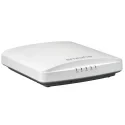
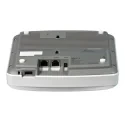
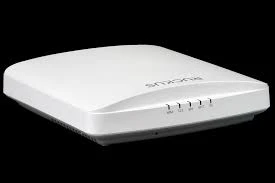
The Ruckus R650 is a dual-band, indoor Wi-Fi 6 (802.11ax) access point optimized for medium- to high-density environments (e.g. offices, classrooms, retail, libraries).
It supports concurrent operation on both 2.4 GHz and 5 GHz bands, with a total of six spatial streams (4×4:4 on 5 GHz and 2×2:2 on 2.4 GHz) to maximize throughput and client capacity.
The R650 also includes features for Internet of Things (IoT) integration (BLE, Zigbee), advanced antenna design (BeamFlex+), and intelligent radio/channel management (ChannelFly) to cope with interference and dynamic wireless environments.
Here are some of the standout features of the Ruckus R650:
| Feature | Benefit / Purpose |
|---|---|
| Wi-Fi 6 (802.11ax) support | Improved spectral efficiency, better throughput in dense environments, support for OFDMA, TWT, and MU-MIMO |
| 6 spatial streams (4×4:4 at 5 GHz + 2×2:2 at 2.4 GHz) | Enables more simultaneous data streams and improves capacity |
| High peak data rate | Up to ~2,974 Mbps combined (across both bands) |
| 2.5 GbE backhaul (Ethernet port) | Ensures that wired backhaul is not a bottleneck for high wireless throughput |
| BeamFlex+ antenna technology | Adaptive multi-directional antenna patterns to mitigate interference and extend coverage |
| ChannelFly dynamic channel selection | Automatically switches channels to avoid congestion and interference |
| IoT radios (BLE, Zigbee, modular support for other IoT) | Lets the AP act as a hub for IoT devices and unify separate network silos |
| High client capacity | Designed to handle many client devices concurrently (512 clients mentioned) |
| Ruckus advanced software features | Examples: Airtime Decongestion, Transient Client Management, SmartLoad, adaptive band balancing, application recognition, QoS, ACLs, etc. |
| Flexible management | Support for physical or virtual controllers, cloud management options, or Ruckus’ management platforms |
Below is a more granular look at the specifications:
| Parameter | Value / Description |
|---|---|
| Radio / Bands | Dual-band, concurrent (2.4 GHz + 5 GHz) |
| Spatial Streams | 5 GHz: 4×4:4 2.4 GHz: 2×2:2 |
| Max PHY Rate / Throughput | ~2,974 Mbps combined (across both bands) |
| Client Capacity | Up to ~512 clients (practical design target) |
| Ethernet (Backhaul) | 1 × 2.5 GbE port (supporting multi-gigabit uplinks) |
| USB | USB 2.0 for external use/expansion (as applicable) |
| Receive Sensitivity | (Examples) 2.4 GHz (HE20, HE40) — MCS0: –93 dBm, MCS11: –64 dBm 5 GHz (HE80) — MCS11: –64 dBm |
| Tx Power (per chain) | e.g. 2.4 GHz MCS0 HT20: ~22 dBm, others lower depending on modulation and regulatory limits |
| Antenna | Integrated BeamFlex+ multi-directional antennas, adaptive patterns |
| IoT / BLE / Zigbee | Built-in BLE and Zigbee radios. Also supports modular IoT modules to add further wireless protocols |
| Physical / Environmental | (From datasheet) Dimensions, weight, operating temperature, humidity tolerances are in the detailed datasheet. |
| Software / Features | Airtime Decongestion, ChannelFly, SmartLoad, band balancing, QoS, ACLs, application recognition, load balancing, roaming, RF optimization, etc. |
| Management | Supports management via Ruckus controllers (physical/virtual), cloud, or other Ruckus management platforms |
| Certifications / Regulatory | Meets certifications applicable to Wi-Fi, safety, EMC etc. (Check local/regional certifications as needed) |

No review given yet!
 Fast Delivery
 Safe Payment
 7 Days Return Policy
 100% Authentic Products


You need to Sign in to view this feature

This address will be removed from this list
 english


